Friday, 23 May 2014

St James, Lancaut

This little church has been a ruin for many years, but there are plans to stabilise the walls to prevent further deterioration.

There was once a leper colony here and there are six squints (peepholes into the church) at the east end of the building; 2 in the east wall and 2 each in the north and south side walls at the east end. Most churches would have only had one squint for those who were not allowed to enter the building for health reasons, such as leprosy.

The stonework shows the different building stages and it looks as though the original square church was extended eastwards at some time fairly early in its history. The stonework for the east window was re-used with extra stones added for the thickness of the walls.

The notice board gives a brief history of the church and when it was last used for services


Monday, 19 May 2014

Tintern Abbey

Tintern Abbey was a Cistercian monastic foundation and one of the largest and most advanced of its time. The abbey church still stands to above window height including the stone tracery of the east and west windows. All Cistercian abbeys were dedicated to St Mary and there is a modern statue of the Virgin and Child (holding a bird in his hand) in the south aisle. The cloisters with remains of the monks reading cells are on the north side of the abbey.

There is more historical information here.


Tintern Abbey the external buildings

The abbey had a wide range of buildings - the cloisters; monks cells; infirmary; kitchens; guest room; Abbots dweiing etc. All these were built to the north of the abbey church. It is still possible to see fireplaces in some rooms, the stone built kitchen cupboard and the layout of the buildings as a whole. The changes to the roof lines as the building developed can also be clearly seen.


Tintern Abbey - the drainage system

The drainage system at Tintern Abbey is well preserved and runs from the kitchens through to the infirmary, monks quarters and the Abbots dwelling. It was the most advanced system of its time with side drains running into the main drain (bottom left) which emptied into the River Wye. The seat in the infirmary toilet (bottom right), and others including the Abbot's,would have been a little hard!


Sunday, 18 May 2014

Offa's Dyke Way

Our next walk was along Offa's Dyke (an Anglo Saxon word for an earth bank), dividing Wales from England constructed by King Offa in the 8th century. The walk started just north of Chepstow and there was a brief glimpse of Chepstow Castle across a building site. Then along a walled path leading to a meadow. At the top of the hill is an old watch tower, built to look across the Wye into Wales and over the hills back into England.

The walk should have then continued through the Lancaut Nature Reserve to the church of St James. however just through the gate was a sign warning of a serious landslip and danger for walking on scree and mud. We turned back and took the right hand fork along Offa's Way again until we crossed a main road. At this point we decided to return the way we had come and then attempt to reach St James church another day from the northern end of the reserve.


Bluebells - Forest of Dean

We have just spent a week in the Forest of Dean, instead of our usual walking in Spain. The woods nearby were full of bluebells ad the tracks reminded us of the Camino. The weather was good and the tracks mostly dry although not all were clear and we encountered one which was blocked by a landslide. However we found an alternative route on another day and reached a little church near the River Wye. Now home we are sorting out the photos so here are a few from the first day in the bluebell woods. The sign at the side of the road was interesting as it records the road being built to improve an old track.


Sunday, 23 March 2014

Spring is coming

Finally the tracks are drying up enough to walk 'off road' and through the woods. Daffodils are flowering as well as primroses and the violets are just coming out too. There were deer on two walks lately, these two were standing watching us for some time before moving on. Fallen trees in the woods have been cut to allow walkers through, often by simply removing the section blocking the path. Several good walks lately in fairly warm dry conditions although it is colder again today. At last we can look to walk a little further afield rather than keeping to the roads near home. Even if not walking the Camino until next year we still need to keep in practise.


Friday, 21 February 2014

A fine day

A fine day at last and a 13km walk in the surrounding hills. Stopping by a bridge over a stream we heard a crashing in the bushes and a deer ran out. Two of them ran across the field and then stopped before running on and through the hedge, where one stopped to look back.

Snowdrops are appearing in the bank sides and the water levels are finally going down. Walking is still on the roads and will be for the foreseeable future as the fields and tracks are still too wet to use. We are in training and see no need to get too wet or muddy un-neccessarily.


Saturday, 11 January 2014

Floods (again) and frogs

Th end of the year brought only minor flooding to our area, but enough to make walking difficult with some of our walks under water in places. The stream had waves on it as it cut away at the bank by the tree. However this week walking has improved and we look forward to at least a short spell of better walking. We need the practise as we prepare for the Camino again.

The frog was actually a stone relief we saw on a housing estate. Hopefully the frogs in our pond are keeping themselves well tucked away. One froze last year, but so far this winter has been milder.


Tuesday, 19 November 2013

November - Trees

Autumn is with us and winter is just around the corner. Walking is now on the roads mostly as tracks are muddy, although we did get round the woods yesterday. Today there are reports of some places having snow showers, but we have not had any so far. In the sunshine the tree leaves are golden, but falling fast. Time to put on our woolly hats and gloves when walking.


Saturday, 26 October 2013

Camino del Mar - Camino Inglés:- 2014

The cruceiro at Buscas on the Camino Inglés


In 2014 we hope to walk from Ribadeo along the coast on the Camino del Mar. This then turns south, after San Andres de Teixido, and goes through Xubia to join the Camino Inglés at nearby Narón. We expect to walk between 10 and 15kms most days, with occasional longer stretches. Research at present is looking at ways to make this possible as there is limited accomodation in some parts.

You will find more later on the new blog Camino del Mar - Camino Inglés.

Thursday, 24 October 2013

October Walking

October has been a time of mixed weather, bringing with it the need to start walking the roads rather than the tracks. In one place a local group has cleared the old bridge where there was also once a ford. The road here can still flood so the bridge will be useful maybe at times. We made use of it just for fun this week.

With increasingly wet days many walks have been fairly early, before the rain starts. The low mist reminded us of the mornings near Tineo.

Tuesday, 1 October 2013

September Walking

Walking around:- This time along the Trent and Mersey canal side. Very flat compared to our normal style of walking. We found a good pub/restaurant,the 'Plum Pudding, on the canal side in Armitage - near Rugeley. They made us an excellent mushroom omelette for lunch, after which we retraced our steps back to the car.

Monday, 1 July 2013

Arriondas to Plymouth: 21st-23rd May

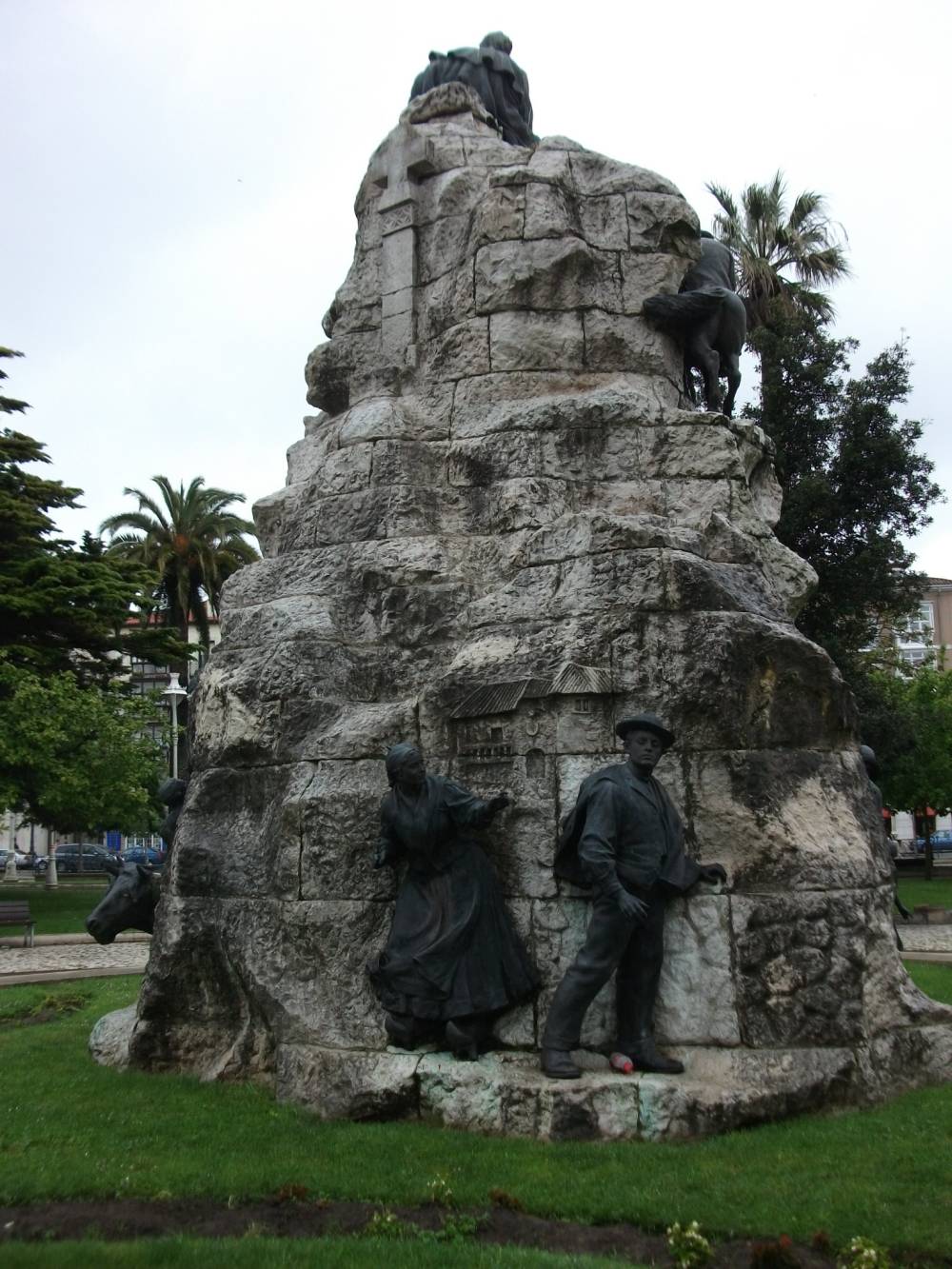
Our final travelling took us from Arriondas, on the FEVE again, to Santander for the night of the 21st. Here we had time to walk in the city, including visiting the Pereda Park, near the ferry port. There is a monument to José María de Pereda (1833-1906) here, with bronzes on each side representing scenes from his books.

Then it was time for the ferry, leaving in the evening of the 22nd and arriving in Plymouth the following afternoon. Our walking on the Camino over for another year we will return to walking at home, but are thinking already about a possible return to Spain sometime next year.


Santander:

The monument

View to the mountains, as we sailed


Arriving in Plymouth Sound

The cow bell and shell tile